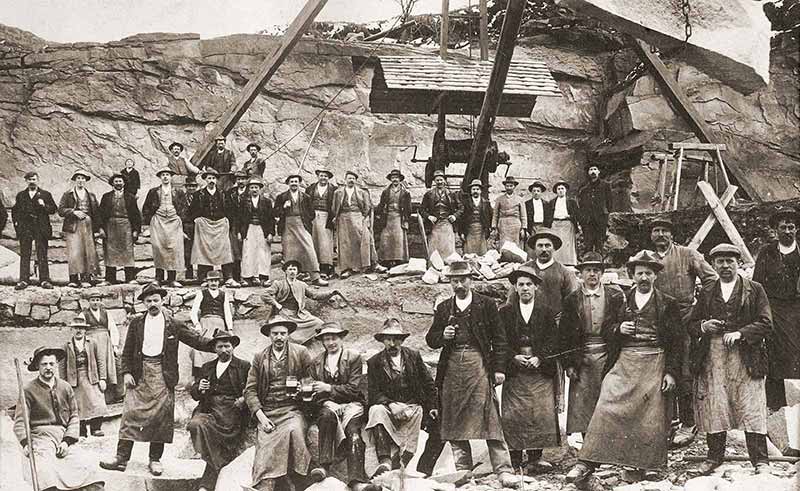
The quarry we are in is called the Kinadeter-Schachet. “Schachet” is the local name for this field. Josef Kinadeter opened the quarry in 1885, and the Kinadeter-Schachet became the nucleus of the Hauzenberg granite industry. The quarry remained in the possession of the family until its closure.
I have a very special, let’s say familial connection to this place because my great-grandmother Carolina was born a Kinadeter. She also opened a granite quarry later on with her husband, one which my parents still run today.
But back to the local Kinadeter-Schachet quarry: the granite from this quarry was a very sought-after stone. Countless monuments and gravestones were made from it. In Munich, entire streets are paved with granite from here.
As early as 1889, Josef Kinadeter introduced a conveyor system to the quarry and, in 1910, he extended the facility by adding two tracks. The stonecutters’ sheds, a sawmill and a grinding shop were located outside the quarry, roughly where the road runs today.
One major problem with the quarry was its proximity to the village. The disturbances caused by blasting and noise led to constant complaints. In 1985, operations were finally brought to an end.
The quarry basin has been filled with water ever since. The small lake out there is about eight meters deep.
The pictures in front of you are of the Kinadeter-Schachet quarry, images which span from its beginnings until the end of the 20th century.
Now, you’re invited to join me for a tour of our show quarry. You’ll hear from me again at the steel panel which you’ll find just after the exit.