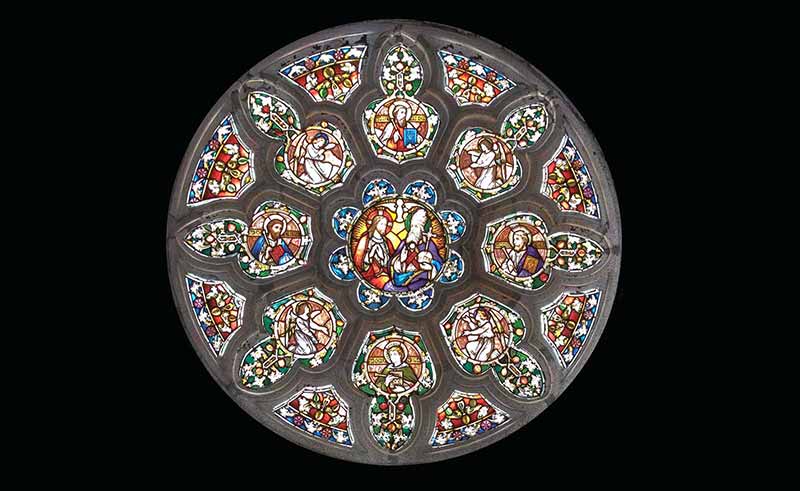
The rosette window in front of you and the pointed arch, tracery window behind you have been faithfully reproduced here in the Granite Center. The medieval originals can be found in the Hohenfurth Monastery, in today’s Vyšší Brod in Czechia. There in southern Bohemia, and in Austria’s Mühlviertel region, magnificent examples of Gothic stonemasonry can still be found. They existed in the southern Bavarian Forest, as well, but these works largely fell victim to modernization.
A culture of high-quality stonemasonry developed during the Middle Ages in this region shared by three countries. This was, in part, due to its location between the important cathedral workshops in Passau and Prague. The technical and creative knowledge was spread by the traveling stonemasons. Qualified journeymen had to spend three years on the road after their five-year apprenticeship, and veteran professionals were in demand on building sites throughout Europe.
We can only salute the skills of the stonemasons of this era. Using the simplest of tools, they created outstanding works of technology, art and craftsmanship.
Take a look at the pictures of the old masterpieces. To the left of the rosette window you can see examples from the 11th to 13th centuries. This period is known as the Romanesque period. To the right you’ll find works from the 14th to 16th centuries. This golden age of stonemasonry, known as the Gothic era, is known for its intricate tracery and highly complex, ribbed vaults. Examples include work from monasteries and churches. The numerous, mighty castle complexes have only survived the times as ruins.
Do you see the cross pillar up there? Some also call such field monuments “wayside shrines” or “wayside crosses.” We’ll meet again there.