The building you’re standing in front of has two functions. On the left you can see the canteen, and on the right the quarry forge.
It was common for canteens to be set up in larger companies. Here, a canteen manager offered a hot meal at lunchtime, or the workers could heat up the food they had brought with them. The canteen also served as a room for warming up, as the workers in the quarry and in the exposed work sheds were almost entirely unprotected from the weather.
Many tales surround the canteen, telling stories of excessive alcohol consumption and so-called ‘blue Mondays’ when workers skipped work. However, the vast majority of stonecutters simply could and would not afford this. Exaggerated stereotypes of brawling and hard-drinking stonecutters stubbornly persist, nevertheless.
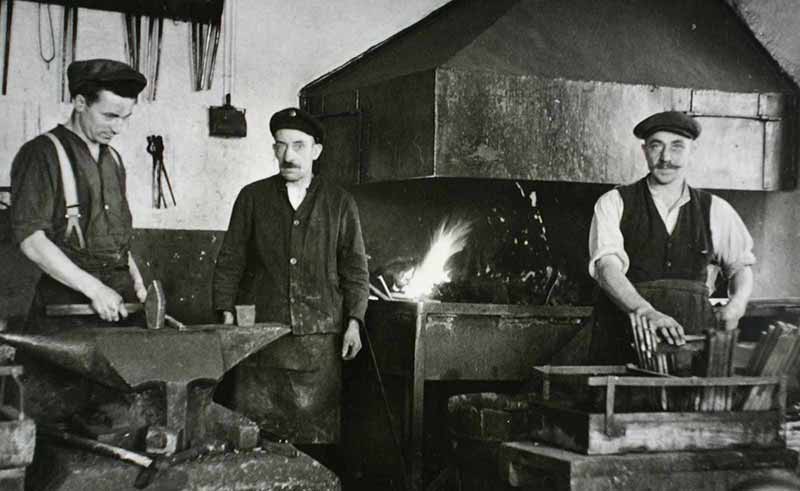
At least as important as a good lunch is a sharp steel blade. That’s why every quarry needed a forge. The tools, worn down by the hard and brittle granite, had to be regularly reconditioned. Every stonecutter had his own shelf in the forge where he put his worn-down tools and where he found them again, hardened and sharpened.
Now let’s take a closer look at the stonecutters’ workplaces. Walk along the lakeshore to the rock face. There, we’ll meet again.